Showing posts with label Wealth Building. Show all posts

Friday, 20 April 2018

Investing for Those Starting at Zero

Investing for Those Starting at Zero by Andy Tanner

Investing for Those Starting at Zero

Over the past decade and a half I’ve had the chance to teach investing and money concepts to tens of thousands of people all over the world. And I’ll tell you, the results for each of these people is exactly the same. As you pursue your journey to become an investor, you can gain an important new vision of how money works. You’ll never look at it the same way again. Your confidence will grow. And you’ll have a great time along the way.
I’m the author of two books, Stock Market Cash Flow and 401(k)aos that help people learn some of the problems they are facing with retirement. I also show you how we can solve these problems.
The road to becoming a successful investor might have some bumps along the way. It’s completely normal. Bumps in the road do not mean that you are failing. It just means you’re on the journey.
With each of my own failures along the way, I have faced a point of decision to either move forward or quit. When you decide to stand up and move forward, you transform that failure into a lesson learned rather than an ending point to the story. I’m so grateful for my mistakes. I know that sounds weird. I’m not saying they were fun, and I’m not saying I want to repeat them.
One of my greatest mentors is Robert Kiyosaki. He’s the author of Rich Dad, Poor Dad, the best-selling personal finance book of all time. I’ve had the chance to work closely with Robert and his personal team during my time as a Rich Dad Advisor for paper assets.
For those who really know Robert, he’s much more than an author. He is an entrepreneur and an investor extraordinaire. One of the most powerful lessons I’ve ever learned from him is this: “We must know the difference between an asset and a liability if we are going to invest successfully.”
My purpose isn’t to help the person who already has millions of dollars. Instead, my goal is to help the single mom starting from scratch. It’s for the father who was wiped out by medical bills and is trying to climb out of bankruptcy. This is for the college student who is struggling to find a field of study she feels passionate about, and deeply wants to become an entrepreneur.
I have started businesses and purchased real estate without any money. The purpose of this article is to help you begin to see how anyone can start at that same beginning point and find success. Whether your desire is to start a business, invest in real estate, trade stocks, or buy commodities, this information is designed to help you achieve your goals even if you have nothing to start with.
At this point in your journey, don’t become too preoccupied with getting across the finish line. Instead, I want to help guide you to the starting line. I don’t believe there’s any one recipe I can hand you that will magically make you millions. What I can give you are the principles used by the rich every single day. As a result, you will gain an understanding of how you can create something valuable from nothing.
In my travels I have met tens of thousands of people who have the heart and desire to succeed, yet feel the heavy challenge of starting at square one with nothing.

Doesn’t It Take Money To Make Money?

All of us carry a lot of beliefs about money, and our beliefs tend to guide our actions, our feelings, and our thoughts. By the time you finish going through the Nine Secrets of the Rich that I have put together for you, I am willing to bet that you will no longer believe that it takes money to make money. If you do, perhaps investing on your own isn’t the right path for you.
There are two reasons why I believe this notion of needing money to make money is false:
  1. My personal experience has taught me that it’s 100% possible to achieve good success when starting with no money. I have personally reaped many thousands of dollars in cash flow for me and my family starting with nothing. And I’m going to show you examples of that, large and small.
  2. In my circle of friends and mentors, I’ve seen firsthand how other people have accomplished the same thing. They have shown that it doesn’t take money to go out and make money. I’m going to show you many of their techniques, philosophies, and how simple it can be for an average person to do the same thing.

Here’s even more proof for you. Consider the following famous wealthy people:
  • T. Boone Pickens is an oil and gas investor worth about $1.2 billion
  • Donald Trump is an icon in real estate, and his wealth is worth somewhere between $3 billion and $7 billion
  • Richard Branson is an amazing businessman with multiple companies under his Virgin brand, currently worth about $4.5 billion
  • George Soros is known as a master of paper assets (my favorite, of course) and is worth about $20 billion dollars
  • And Warren Buffet, perhaps the greatest investor ever, is worth about $53 billion according to Forbes, and he has had success in almost every asset class
Now think about this: What if we took away all of the wealth of these people by taking every last penny from their bank accounts. Where do you think they would be in five years?
Since they don’t have any more money, do you think they would be destined for poverty?
Would we see them on the streets homeless without hope of ever getting it back?
Or do you believe that they would find their way back on top?
When I ask this question to groups of investors, almost everyone realizes that these icons would become rich again. If that is true, how could they do it? If it takes money to make money, how can a person that is absolutely penniless climb up to the highest levels of wealth again?
Is it because of dumb luck happening again and again to the same person?
Or is it because they possess some type of knowledge that other people don’t have?

The Answer Is Education

These people, and many others, have risen to the top for a reason. They have taken responsibility for their financial education and learned how to invest properly and wisely. They didn’t take shortcuts. They continually improved their financial education levels until the inevitable outcome was huge success.
If a person wants to be a concert pianist, the only thing that stands between where they are now and performing on a stage is training, mentors, hard work, and time. The catalyst for everything is education.
You will see that the secret ingredients to every worthwhile investing strategy are education and effort. If you are willing to put in a little work, a little time, manage risk wisely, and get out of your comfort zone, you can begin to experience your own success.
My greatest concern in showing you how to invest with no money is that some people may assume that they don’t have to do anything. There will still be important lessons to learn and legwork to be done. There are no shortcuts. In the end, though, I believe you will find it’s worth the effort.
Source: http://www.richdad.com/Resources/Rich-Dad-Financial-Education-Blog/April-2018/Investing-for-Those-Starting-at-Zero.aspx


Thursday, 15 March 2018

Turn $40 into $10 million - Grant Cardone & Warren Buffett


What skills does it take to turn $40 into $10 million?

Find out in this great video from Grant Cardone and the one and only Warren Buffett!

Friday, 9 March 2018

5 COSTLY INVESTING MISTAKES


#1 WRONG ASSET ALLOCATION

The top financial minds in the world differ in their strategies and approach to investing, but the common denominator is how they avoid making the following mistakes. Whether you are brand new to investing or you are a seasoned investor, you could be making these investment mistakes.
Anybody can become wealthy; asset allocation is how you stay wealthy.
Asset allocation is the most important investment decision of your life. It’s something that most investors may have heard of (or even fully understand) but know little about the practical application. Asset allocation protects you from a lack of diversification, from falling in love with one type of investment and not owning a variety of different types of assets.
However, asset allocation is more than just diversification. You may be diversified across asset classes or investment types, but are you also diversified across risk?
Asset allocation means dividing up your money among different investment classes (such as stocks, bonds, commodities, or real estate) in specific proportions that you decide in advance, according to your goals, needs, risk tolerance, and stage of life. 
Yes, that’s a mouthful! Let’s walk through what that really means for you.
In order to create successful asset allocation think of it as your favorite sports team. The best teams have both an aggressive offense and a strong defense. And, most importantly, the coach knows the strengths and weaknesses of each. You want to set up a specific proportion of your portfolio as your tail end, or defensive position – we call this your Security or Peace of Mind bucket. In this bucket you will allocate lower risk assets, designed to protect you if your offensive players take a hit.
You will then set aside a specific portion of your money to be your offensive strategy – this is your Risk/Growth bucket. It is named this because although it will likely be the real wealth-growing portion of your portfolio, it is also the riskiest and most volatile.
Finally, you have a Dream bucket. This is for the really fun things you want in life. The dream vacations…the outrageous gifts… you fill in the blanks. You can fill this bucket by setting aside a proportion of your money like these other two or you can fill it when you have big wins – like a big bonus. This bucket isn’t meant to give you a financial payoff; it’s designed to give you a greater quality of life and keep you inspired to keep making your dreams a reality.
Because asset allocation is the most important investment decision you will make, it’s very likely that you’ll seek help in building that portfolio and filling those buckets. Take advantage of a free evaluation of the health of your own asset allocation and see how you compare to professionally designed portfolios. And when you do seek help, be sure not to make mistake number two.

#2 USING A BROKER INSTEAD OF A FIDUCIARY

You may have recently heard President Obama exhorting the Department of Labor to update their regulations of the financial industry and implement a fiduciary standard.
Why is the executive office concerned about the regulations of your broker? Because currently, brokers – also known as registered representatives, financial advisors, wealth advisors and more – are held to a “suitability standard” which does not require them to have their client’s best interests in mind. (Learn more about the fiduciary standard here.)
They oftentimes work for large, name-brand firms that are working only to make a profit. So, the person you turn to, although kind and trustworthy, is working in a closed-circuit environment, where the house it set up to win. A fiduciary, on the other hand, is independent and free of conflicts (or, at a minimum, they must disclose). A true fiduciary advisor never receives commissions to sell you a specific investment, or what you might call “having a dog in the fight.”
So what does it cost you to receive conflicted advice?
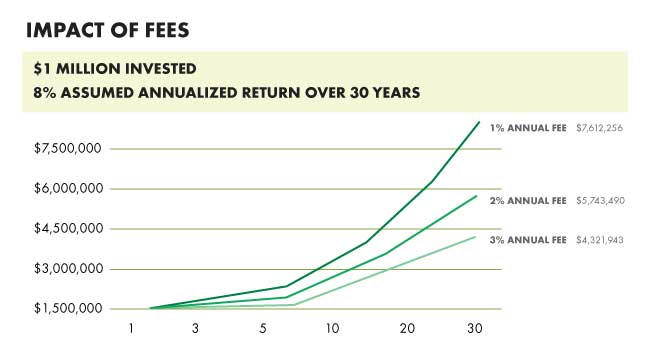
Using a broker instead of a fiduciary costs Americans one percent point of their return annually, according to The President’s Council of Economic Advisors. One percentage point may not sound like much, but one percentage point lower return could reduce your savings by more than a quarter over 35 years.
In other words, instead of a $10,000 retirement investment growing to more than $38,000 over those 35 years (after adjusting for inflation), it would be just over $27,500.

#3 INVESTING WITHOUT TAXES IN MIND

Insiders know that it’s not what you earn that matters, it’s what you keep. In fact, tax efficiency is one of the most direct pathways to shorten the time it takes to get from where you are now to where you want to be financially.
Did you know that the average American will pay more than half of his or her income to interest expense and taxes (income tax, property tax, sales tax, tax at the pump, etc.) over the course of their lives?
You can guarantee that this seriously impacts your ability to created compounded growth for your future life. There is no good reason to pay more in taxes than you have to, and every reason to avoid unnecessary taxes. Tax efficiency = faster financial freedom. Talk to your registered investment advisor, your CPA and utilize resources such as MONEY: MASTER THE GAME and this blog to discover 100% legal strategies for maximum tax efficiency.

#4 OVERPAYING FOR HIGH-COST MUTUAL FUNDS

For years, we have been sold the lie that mutual funds are the most effective way to grow our 401(k)s. Unfortunately, it’s just not true. The truth is that 96% of actively managed mutual funds do not beat the market over a 15-year span. Active managers are trying to beat the market by being a great stock picker. And the 4% that does beat the market is changing all the time, so betting on a jockey that won the last race does not mean that he will win again. Chasing performance is a fool’s errand.
How badly does this actually hurt us? Over a 20-year period – December 31, 1993 through December 31, 2013 – the S&P 500 returned an average annual return of 9.28%. However, the average mutual fund investor made just over 2.54%, according to Dalbar, one of the leading industry research firms. That’s nearly an 80% difference!
To add insult to injury, the “all-in” cost of mutual funds is on average 3.17% per year, according to Forbes. This is when you add the management fees, the transaction costs, the sales loads, etc. Perhaps this number doesn’t sound high to you. Consider this: The market was “flat” between 2000 and 2009, a period known as the lost decade. There were lots of ups and downs, but nobody made money. If you were paying 3% annually during this period, your $100,000 portfolio would have approximately $70,000 (or be down 30%) at the end of this “flat” period.
You put up the capital, you took all the risk — and they made the money.

#5 FAILING TO DEVELOP THE DISCIPLINE OF REBALANCING

To be a successful investor, you need to rebalance your portfolio at regular intervals. This means you have to take a look at your buckets and make sure your asset allocations are still in the right ratio. From time to time, a particular part of one of your buckets may grow significantly and disproportionally to the rest of your portfolio and throw you out of balance.

Let’s say, for example, you start out with 60% of your money in your Risk/Growth bucket and 40% in your Security bucket. Six months later, you check your account balances and find out that your risk/growth investments have taken off and they no longer represent 60% of your total assets – it’s more like 75%. That means that only 25% of your money is safely in your security bucket. It’s time to rebalance!
The challenge with rebalancing is the emotional and psychological discipline it takes to actually do it. When a portion of your portfolio is doing really well, it’s easy to be hypnotized into the illusion that your current investment successes will continue forever, or that the current market can only go up. This is what causes people to stay with an investment too long and end up losing the very gains (and often more) that they were originally so proud of. The rules of rebalancing don’t guarantee you’re going to win every time. But rebalancing means you’re going to win more often.
How often do you need to rebalance? Most investors rebalance once or twice a year. Some rebalance more frequently, choosing to watch their portfolio more closely and adjusting when it starts to shift, but too frequently can hurt you as it doesn’t give a chance to “let your runners run.” The number of times you rebalance does have an impact on your taxes, however. If your investments are not in a tax-deferred environment, and you rebalance an asset you have owned less than a year, you’ll typically pay ordinary income taxes instead of the lower long-term investment tax rate.
Images copyright @connel/shutterstock, @Phase4Studios/shutterstock, @Anatoli-Styf/shutterstock
Team Tony
Team Tony cultivates, curates and shares Tony Robbins’ stories and core principles, to help others achieve an extraordinary life.
Source: https://www.tonyrobbins.com/wealth-lifestyle/5-costly-investing-mistakes/

Tuesday, 6 February 2018

Some Nuggets on How To Be Rich

Everyone no matter their age, they all want to know how to be rich, how to hack life and make it financially. The significant driving force has been the perception that wealth or money means everything or can buy you all and make you happy. Millions of books have been written since the ancient times and yet you will find yourself looking for more and hopefully direct and easy ways around how to just make it. Well, you did great reading this article since you will see that most of what you need to make it you already have it.


Most young people just want to hack life and make it all at once without that effort nor patience of learning. This has created severe habits such gambling and fraud as a means to get rich quick. The other vice that has risen due to the elusive fact that all can make it is a generation of desperate and drug-addicted youths who believe that their fate is already sealed. This article is a wakeup call and a call to action to drop page thumping and expecting to find that one magical trick. You are all that you need.
How to start.
To begin with, by reading this means that you are ready and willing to make something out of yourself, get your head straight now and acknowledge that you have a working brain and a desire to make it.
The second move is to dream and make sure that you do not just imagine. The moment you can visualize anything in your head means that you can be able to make it happen for real.
Go ahead and write down your plan and evaluate how you are planning to achieve that. This, therefore, has to begin with small ideas and seeing them through. You cannot start planning for a Ferrari, and you do not own an account even. Start small and be patient to look at the fruits of your hard work.


Patience as a value comes in hand even when managing your wealth later in life. You have to carry out planned and well-calculated risk and wait patiently and trust in yourself that it will work.
The other thing is growing some balls because the moment you start investing you will have to be ready for risks and failures. Do not dwell on the failures instead move on and have better plans, do not lose focus but keep the desires, and all will work eventually.
Lastly, when you start making something, reinvest and work to grow bigger. Instead of celebrating and blowing up everything take it back and let it grow. Always have the mentality of safeguarding the capital you input at any time and then re-invest the profits for growth.
Conclusion.
The smart ones only win the money game and wealth creation. By accessing such information, you have been made smart, and that means you can go forth and grow yourself to whatever level you want.


You can always find more interesting articles here or hire my writing services. Reach me via mikiepirate12@gmail.com
Article Source: https://EzineArticles.com/expert/Mike_P._Egan/2437440
Article Source: http://EzineArticles.com/9875782

Wednesday, 24 January 2018

4 Current Commodity Tips You Need to Know About

Commodities are an incredibly strong investment choice. A great way to build a diverse portfolio, they lack the volatility of stocks while providing great room for financial growth.
But investing in commodities without knowing what you're doing is a bad idea.
If you want to make this investment, you'll need to develop an intelligent strategy. Here are some commodity tips to help you make that move.


Commodities Explained
Before you read any other commodity tips, you need to understand the concept. Commodities are structured trades around the delivery, sale, import, and export of a particular good. Popular commodities include oil, gold, and soybeans.
The most popular strategy for investing in commodities is signing a futures contract. These ensure that you will own the commodity for a set amount of time before selling it on a certain date at a specific price.
Here are a few tips for making the most out of your commodity trades in 2017.
Why ETFs Are A Good Choice
If you're looking for an effective way to invest in commodities, one of the best ways to do it is through ETFs. ETFs, or Exchange-traded funds, can either monitor a commodity or a specific market index.
ETFs can be a great way for beginners to invest in commodities. They are easy to manage and involve a lot less red tape than a futures index. While investing in ETFs is not the only way to make a profit off of a commodity investment, it is the best way to get acquainted.


How To Use a Short Position
Many have a strong preference for the simple game of going long on their commodities. But this can be a mistake. There's a lot of money to be made off of the short sell, and it also isn't particularly difficult.
If you detect a market depreciation, you should sell shares in a commodity. Let the commodity depreciate in value: when you feel it has bottomed out and will experience a resurgence in value, you should buy shares.
This will allow you to minimize the cost of purchasing valuable commodities while profiting off of purchases of a commodity at a low value. Every trader should stop worrying and love the short.
Read The News (Financial and Otherwise)
Commodities are very complex. But in a way, they can also be relatively simple to understand. As a matter of fact, indexes for every commodity from corn to currency will appear in the newspaper. And not just in the business section.
Staying on top of everything from policy to boardroom rumors can help you make the right decision. So devote at least an hour to the news each day.


Be An Oil Skeptic
Oil is one of the most popular commodities. And while it can perform well or poorly in various technical analyses, an essential part of risk mitigation involves taking a look at the international political environment.
Whether it's through long-term transformations in the energy market or instability in OPEC nations, the future for oil is questionable. In the name of risk mitigation, we would advise approaching oil with caution.
Beyond Commodity Tips: Work With The Best
Tips can take you far. But you can go even further by working with seasoned financial professionals.
Work with the experts in various areas of trading. One of these areas is commodities trading. But whether you're looking to succeed at the trading of commodity ETFs or to continue boosting an already thriving portfolio, always look for the best people to work with.


Trade Finance Consultant, Business Development Strategist, Strategic Trade Risk Mitigation Solutions Provider Visit http://www.adamsmith.tv for more details.
It is one of India's leading Trade Finance Company, performing business of arranging trade finance and providing consultancy, advisory, structuring and management services relating to trade finance transactions. One of its main expertise is in commodity trade finance.
Article Source: http://EzineArticles.com/9801348

Tuesday, 23 January 2018

Money, Master the Game. Anthony Robbins


Tony Robbins is a genius in so many ways, and his book on mastering money is a must read!

Learning to invest is critical for building wealth!

Friday, 15 December 2017

Jim Rohn - Financial Independence - (Jim Rohn Personal Development) - Audio


In this a live seminar, Jim Rohn provides an overview of Economics 101, shares stories about super-motivator Robert Schuler, leads you in identifying your philosophy about money, helps you uncover the mystery of the philosophy of being rich and poor, leads you in understanding what to do with a dollar, and explains why keeping strict financial accounts is important. The man many consider to be America's foremost business philosopher has been sharing his success principles and strategies for more than 39 years, with more than 6,000 audiences and over four million people worldwide! He is the author of over 25 books, audio, and video programs. Jim has been hailed over the years as one of the most influential thinkers of our time.
Jim Rohn : Emanuel James Jim Rohn (September 17, 1930 – December 5, 2009) was an American entrepreneur, author and motivational speaker. Jim Rohn's rags to riches story played a large part in Jim Rohn's work, which influenced others in the personal development industry.
Emanuel James Jim Rohn was born in Yakima, Washington, to Emanuel and Clara Rohn. Jim Rohn's owned and worked a farm in Caldwell, Idaho, where Jim Rohn grew up as an only child.
Jim Rohn started Jim Rohn's professional life by working as a stock clerk for department store Sears. Around this time, a friend invited Jim Rohn's to a lecture given by entrepreneur John Earl Shoaff. In 1955, Jim Rohn joined Shoaff's direct selling business AbundaVita as a distributor.
In 1957, Jim Rohn resigned Jim Rohn's distributorship with AbundaVita and joined Nutri-Bio, another direct selling company. It was at this point that the company's founders, including Shoaff, started to mentor Jim Rohn. After this mentorship, Jim Rohn built one of the largest organizations in the company. In 1960 when Nutri-Bio expanded into Canada, Shoaff and the other founders selected Jim Rohn as a vice president for the organization.

Saving for the Future While Paying Off Debt

How can you save for the future when you're still paying off the past?