In this video Dan Lok, The King of High Ticket Sales says 'If you ever want to be rich, you've got to work smart' Find out how hustling only makes you tired not rich.

Showing posts with label Rich. Show all posts
Showing posts with label Rich. Show all posts
Monday, 28 May 2018

Saturday, 21 April 2018
The 4 Money Principles That Will Make You Rich

Everyone wants to be rich, to have enough money to live and create their dream life without the need to work for someone else to make that money.
But most people believe that it is only the very lucky who will get there, or have to rely on a lottery big win to ensure that happens in life.
Here’s the truth – ABSOLUTELY ANYONE can be rich enough to have the life of their dreams with commitment and dedication.
All you have to do is know and trust a few simple money principles and keep your eye on your financial goal.
Here are the four principles tried and tested that will get you to your goal.
Step 1: Start investing in your future today and DON’T STOP!
The single most important principle, and the younger you apply it the better, is to pay your future self a portion of every pound you earn right now.
A good place to start is aiming for 10% of your Gross Salary each month to go straight to your future self in Pensions or Investments.
Reason being if you use a portion of your money each month to generate income when you choose to retire from working, you are creating security and income when the days come that you don’t want to or can’t work.
To aim for the Goal of financial freedom and retiring earlier than normal retirement age of 65 – you want to aim for as high a percentage of your Gross Salary as you can comfortably live, and usually at least 25% and above.
Understanding the power of Compound Interest on your money and investments, where the natural laws of time allow your money to grow and multiple faster, is key to this wonder of saving a portion of your money each month.
Normal savings accounts currently offer between 0.1% – 1% interest rates if you are lucky, so do all you can to feel comfortable and research investing in Stocks and Shares to get the maximum return on your money you are investing.
A good place to start might even be to look at ISA accounts (Cash or Investment) where the government will not charge you Tax on your interest increases up to a limit of £20k a year per person.
If you feel confident enough to – Put your money into the stock market, giving someone else your money for short term to make more money with on their efforts and create passive incomes from your savings too.
Never pass up the opportunity for FREE ADDITIONAL Pension contributions from your employer towards your future.
Most companies offer additional pension contributions as a way to effectively pay you a higher wage, without the tax costs to themselves.
If you company offers your matched contributions, make sure you sign up to the maximum percentage you can afford as for every wage you put in they are also adding even more money to it for your future.
Want to become Financial Free? There is even some simple maths to find out the exact amount of money you need to have saved to generate income for life.
Simply take the total amount of money you need each year to live and survive, or have the life of your dreams with, and multiple that by 25 to give you your exact Financial Freedom Goal Number.
Next is to work on a plan to save and achieve it.
Step 2: Spend your money like it was your last penny.
Rich people who stay rich for life spend their money smarter than most people.
They take time to find the best deal, time to consider if they really need that purchase and make sure that it is an investment worth their while and won’t lose money.
Too often we end up mindlessly spending money on luxuries we don’t really need, so perhaps give yourself a 24 hour cooling off period each time you “Click to basket”.
Check if you truly want that item, have found it at the best price possible, before you hit the order button.
Take time to be more mindful with your spending and you will find that the pennies all start to add up quickly to a small fortune.
Step 3: Keep your living costs as low as you can
Minimise all your expenses and keep looking to exchange your hard earned money for what you truly love only.
When you start a journey to financial security or freedom, we need to take time review our spending habits each month and make sure what we spend money on is worth it.
Regularly look for ways to reduce your subscription spending – think car, home insurance, phone contract costs, credit card charges and ask the company for a better deal.
You can save potential hundreds of pounds back into your pocket with a 10 minute phone call and a little effort with comparison websites.
Test your spending every few months by taking non-essential bills (such as that magazine subscription or gym membership) and go “cold turkey” for a week or monthly only. By setting yourself a temporary goal of going without for only a short time, the sacrifice won’t seem so tough and you never know what you might find out about your spending patterns in the past.
Use the 10% Overpayment Rule to get rid of as many debts as you can, if you can without any overpayment penalties.
By paying 10% more on your monthly repayments for any debts, such as your home, car, credit cards and store cards you will very easily and without noticing pay one extra monthly amount towards that debt each year.
That overpayment could take years off your payments, returning more money to your pocket sooner than the bank or company would have liked.
Step 4: Start your own side business.
We live in a world where a single source of income, one job all your life, is no longer guaranteed.
We also live in a world where we have information and resources are literally at the touch of our fingers via the Internet, and absolutely anyone can put in the time to start their own side business.
Look to start a side income to add even more money to build your fortunes with, and also something you are passionate about if possible.
When you are able to control and generate profit from your own business, rather than work for an Employer, there will be no limit to the confidence it will bring in our life and to your earning potential.
By diversifying your household income as much as you can with a few income streams is not only a smart thing to do, but a great way to protect your financial security in the future too with your own talents and merits.
Think about turning a hobby into a small weekend business, or perhaps using a talent from your main job as a freelancer for some income in the evenings.
Over to you now…
Source: https://blog.themoneyshed.co.uk/the-4-money-principles-that-will-make-you-rich/
Monday, 12 March 2018
The Financial Statement Foundation for Being Rich
The key to financial success is understanding the relationship between the income statement and the balance sheet
What does it mean to be rich?
This is perhaps the most important question you can ask and answer. For most people, being rich means making a lot of money. They think that if they can just make a little more each month, all their problems will be fixed. They’ll live like kings and queens.
Living like kings and queens?
So, let me ask you this, would making $100,000 a year make you rich? My guess is that the average person making $59,000 a year would say yes. But like beauty, being rich is in the eye of the beholder.
NPR recently profiled the lives of people living on $100,000 a year. The article sheds some surprising light on the struggles these so-called rich people have. In most cases, the money is quickly eaten away by things like mortgages or rent, student loan debt, and family obligations. In most cases, the people are trying to keep up with the Joneses…but at quite a cost.
One mother, Theresa Sahhar, whose husband’s salary of $100,000 (equivalent to $250,000 in Manhattan cost of living) still works various odd jobs in the gig economy to put her son through a private high-school. She shares with NPR, “I was really surprised because from the outside, it looks like we have plenty of money. But then when you really look underneath it all, you see that people are working overtime. They’re working second jobs and even third jobs to try to put together the money just to stay in the middle class where they’ve been in the past.”
It would be tempting to say that these are just extreme examples…except they’re not. The reality is that $100,000 really doesn’t go that far—especially when you don’t have a robust financial education.
Where financial literacy begins
The reality is that money doesn’t make you rich. What does make you rich is your financial IQ. Give the same $100,000 to a person with a low financial IQ and a person with a high financial IQ and I guarantee you’ll see a vast difference in how that money is spent and grown.
Central to the difference between those with low and high financial IQs is a simple but profound literacy: the ability to understand a financial statement.
One of the most important things you need to know in order to be financially successful is to read an income statement and balance sheet.

But even more important is understanding the relationship between them.
Many people learn in accounting classes how to read an income statement and balance sheet separately. I’ve always found it fascinating, however, that these classes don’t teach why one document is important to the other or how one affects the other.
My rich dad, however, felt that the relationship between the two was everything. “How can you understand one without the other? How can you tell what an asset or liability really is without the income column or the expense column?” he asked.
For rich dad, understanding the relationship between the two allowed you to easily see the direction of your cash flow to easily determine if something was making you money or not.
If something was making money, it was an asset. If not, it was a liability.
“Just because something is listed under the asset column does not make it an asset,” said rich dad. “The reason people suffer financially is that they purchase liabilities and list them under the asset column.”
The magic words are cash flow
It’s this simple insight that explains why those with a low financial IQ are still poor even when they make more than $100,000 a year. They don’t know how to move their money into assets that make them more money. Instead, they spend it all on liabilities and live large paycheck to large paycheck.
To rich dad, the most important words in business and investing were cash flow. He would say, “Just as a fisherman must watch the ebb and flow of the tides, an investor and businessperson must be keenly aware of the subtle shifts in cash flow. People and businesses struggle financially because they have poor control of their cash flow.”
KISS (Keep It Super Simple)
One of my rich dad’s greatest skills was to take complex things and make them super simple. It was one of his rules for investing—KISS, keep it super simple. He had a way of taking complex financial subjects and making them easy enough for even a nine-year-old boy to understand.
I know this because when I was nine, rich dad used the following simple diagrams to teach me the relationship between the income statement and the balance sheet. I still use them to this day.
If you can understand the following diagrams, you have a better chance of acquiring great wealth.
Cash flow patterns
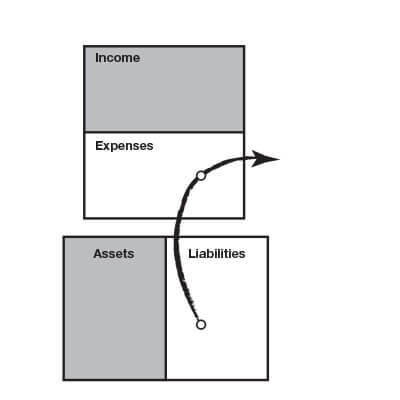
An asset is something that puts money in your pocket. It’s that simple. This is the cash-flow pattern of an asset:

A liability is something that takes money out of your pocket. This is the cash-flow pattern of a liability:
Where it gets confusing
Rich dad pointed out that confusion happens for many because accepted methods of accounting allow for the listing of both assets and liabilities under the asset column.
To explain this, he again drew a simple diagram:
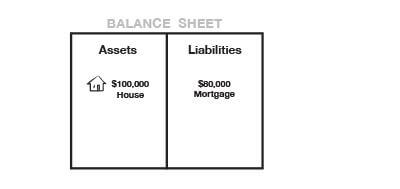
“This is why things get confusing,” rich dad would say. “In this diagram, we have a $100,000 house where someone has put $20,000 cash down and now has an $80,000 mortgage. How do you know if this house is an asset or a liability? Is the house an asset just because it is listed under the asset column?”
The answer is, of course, no. In order to know for sure, you would need to refer to the income statement to see if it was an asset or a liability.
The house as a liability
To illustrate this, rich dad drew this diagram:
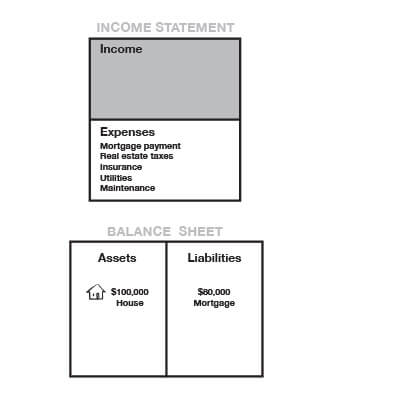
“This is a house that is a liability,” said rich dad. “You can tell it is a liability because it’s only line items are under the expense column. Nothing is in the income column.“
The house as an asset
Rich dad then added to the diagram a line that read “rental income” and “net rental income,” the key word being “net.” That addition to the financial statement changed that house from a liability to an asset.
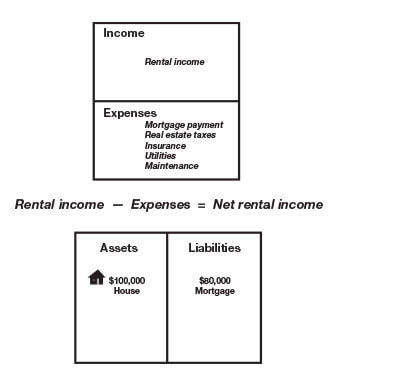
Very simply, rich dad explained, if the rental income of the house, minus the expenses of the house, equaled positive net rental income, the house is an asset. If not, it is a liability.
These simple lessons are profound. And they are the basis for building all great wealth. Going back to my earlier comment, a person with a high financial IQ and $100,000 would be able to know how to invest it in assets that are true assets—ones that put more money back in the pocket each month. The person with the low financial IQ would spend that same money on liabilities, but wouldn’t be able to diagnose what was wrong. Instead, they would try and work harder to make more money—a vicious cycle we call the Rat Race.
Understanding the relationship between the income statement and the balance sheet allows you to quickly understand if an investment is an asset or a liability—and this understanding will allow you to make the right investment every time.
Think you understand how a financial statement works? Test your knowledge and Play CASHFLOW Classic for FREE.
Source: http://www.richdad.com/Resources/Rich-Dad-Financial-Education-Blog/December-2017/the-financial-statement-foundation-for-being-rich.aspx
Sunday, 11 March 2018
You Being Rich Isn’t a Fantasy
How to become a millionaire or multi-millionaire or even hecta-millionaire (100 million units) isn’t taught in schools or colleges. In fact, most ofsociety frowns on anyone who talks about getting rich; some even protest against those who have created financial independence. It’s a funny thing that schools teach you how to read and write, how to domath, how to know history and geography, and how to pass a test—but they never broach the subject of how to get rich. Getting super rich seems to be a topic reserved for fantasies, movies, and drunken what-if games. Most have come to believe that becoming a millionaire is for the lucky sperm club, business owners, gold diggers, lottery winners, athletes, rappers, and inventors. But it’s not true. Millionaires and the super rich come from all walks of life. In fact, just to debunk one of the myths, I’ll tell you that four out of five millionaires today work for someone else.

The reason most people never get rich is that they never even consider it a possibility. They are convinced by those close to them to simply be satisfied with whatever their financial situation is. The other reason is that people fundamentally do not understand money. Very few people know how to get money, even fewer know how to keep it, and almost no one knows how to multiply it. Just look around and you will see signs of this everywhere. Even in one of the richest countries in the world, America, 76 percent of people live paycheck to paycheck, some 50 percent of Americans have no money for retirement, and 47 percent of Americans don’t have $400 for an emergency. If these statistics were true in a poor country, it would be one thing, but America is considered a wealthy country.

Turn on the television or go online and you will see endless, ridiculous financial advice. Financial pundits suggest saving tricks where your path to wealth is finding the lowest price for a product or putting more air in your tires to save gas. This piece of advice always cracks me up: “If you don’t drink coffee out, you’ll save another $700 a year.” You can save $700 a year for the next fifty years and you won’t be rich, you’ll just be old. Another pundit preaches all debt is bad, and that by avoiding debt you will somehow be financially free. “Never borrow money under any circumstance,” the previously bankrupt advisor promotes. He overlooks the reality that almost all the super rich have used debt to multiply their wealth. Flip the channel and you’ll see fancy graphics making a case that you should turn your money over to the boys on Wall Street who, smarter than you, will invest in stocks, bonds, and financial instruments they can’t even explain. Ask your parents for money advice and they will recite their path: get a good job, buy a house, contribute to your 401k, be grateful you have more than most, and pray everything goes right.

I have never wanted to just have “enough,” in fact, truth be known, I have always wanted to be rich. While I do believe in prayer, I don’t expect God to take care of my finances and I certainly don’t want to leave it up to everything “going right.” At a very young age, I noticed how the people who made the decisions and had the power of choice all seemed to be the people with money. I wanted to be one of them. I didn’t want money for the sake of money, but to be able to have the power of choice. At the age of eight, one of my first experiences with money was walking to the local grocery store. I had a quarter in my pocket to spend at the store. I was excited, giddy, and I felt powerful. I was walking to the store with my brother fondling my quarter when I dropped it in the street and it rolled into a manhole. I got onto my hands and knees, only to discover my arms were too short to retrieve the quarter. I got up wet, dirty, angry, and wanting to cry. I remember going home and telling my father how I had lost my quarter. My father said to me, “You shouldn’t play with money.” My grandfather later grabbed me and said, “Son, the problem isn’t simply that you lost the quarter; the problem is that it was your only quarter.” Since that loss I have been fascinated with the idea of amassing enough money so no single event or loss would ever cause me to be without.

If you can relate to what I’m talking about, get on my new Playbook to Millions. It’s a program I put together from my 30+ years of experience going from broke to becoming a millionaire over 100 times over. Later this year I’ll be selling this thing for $5,000 but for those who commit to it early—right now—it’s marked down to just $495. You can and should be a millionaire, and you shouldn’t have to wait until you’re old to become one. Get your Playbook today.
Source: https://grantcardone.com/blogs/grantcardone/you-being-rich-isn-t-a-fantasy
Wednesday, 14 February 2018
The Best Financial Advice for Getting Rich - Grant Cardone
Have you seen inside Grant Cardone's millionaire booklet? Want a sneak peak?
Check out this short video!
Saturday, 16 December 2017
Differences Between The Rich And The Poor
Have you ever wondered what the difference is between the rich and the poor? Why are some people wallowing in the abyss of poverty while some are swimming in the ocean of stupendous wealth?

Sometimes it may come across to you to say that some people are rich because they were born with a silver spoon in their mouth. Well, that is not conclusive because there are many people out there that were not born under any silver linen whatsoever, yet they are millionaires today. What happened? What made the difference? Now here is what i have realized.
The difference between the rich and the poor is the mindset. The rich and the poor think in different frequency. The poor do not have that kind of mindset that the rich individuals have. They approach the same issue from a different perspective and stance.
The rich seek out opportunities. The rich are always seeking for opportunity that will grow their wealth while the poor man wallows in self-pity and he is consumed with seeking for sympathy. He engages in the blame syndrome; blaming his relatives, friends, the government, even the rats in his house are not left out, as been responsible for his predicament. Instead of thinking how he could break out of the cocoon of his abject poverty he feeds it by consistently looking for a scapegoat. With such mindset you can't recognize opportunity for wealth when you see one.

The rich acts but the poor just passes along. When the rich sees an opportunity that will accelerate his wealth, he grabs it. Not the man with a poor mindset. He had a thousand and one reasons why what he sees is not an opportunity for getting rich and so his circle of poverty continues, as he will let go of that opportunity. Sorry to say this; it is like casting a gold before a swine, it will not value it.
The rich are ready to take risk and make sacrifices, either it is of time, effort, money etc. The poor mindset considers some risk as being outrageous. They lack the motivation to dare into the world of the unknown. They are satisfied with the world they have come to know. So they keep maintaining the same status throughout their lifetime.
Have you ever wondered why businesses are called ventures? A business man takes risks. I am sure you know about venture capital: that is the money invested in a new company to help it develop, which may involve a lot of risk. But you will find those who have rich mindset take the risk all the same.

A man who does not take risks will end up paying for another man's risk. When you take the risk, others will pay you for it. That is what the rich man knows that Mr Poor mindset does not know.
You need to understand that being wealthy does not mean you lack nothing and being poor does not have to do with the fact that you lack the basic amenities of life. It has everything to do with the mentality you have.
If you are born poor that does not mean you cannot rise to become a millionaire. To achieve financial success you have to change your pattern of thinking. If a poor man thinks the way the rich does and do what they do, he will have the same result and even more.

Fred E. Egba
http://wealthruler.blogspot.com
Article Source: https://EzineArticles.com/expert/Fred_Eche-Ofun_Egba/495102
Article Source: http://EzineArticles.com/8030148
Friday, 15 December 2017
Jim Rohn - Financial Independence - (Jim Rohn Personal Development) - Audio
In this a live seminar, Jim Rohn provides an overview of Economics 101, shares stories about super-motivator Robert Schuler, leads you in identifying your philosophy about money, helps you uncover the mystery of the philosophy of being rich and poor, leads you in understanding what to do with a dollar, and explains why keeping strict financial accounts is important.
The man many consider to be America's foremost business philosopher has been sharing his success principles and strategies for more than 39 years, with more than 6,000 audiences and over four million people worldwide! He is the author of over 25 books, audio, and video programs. Jim has been hailed over the years as one of the most influential thinkers of our time.
Jim Rohn : Emanuel James Jim Rohn (September 17, 1930 – December 5, 2009) was an American entrepreneur, author and motivational speaker. Jim Rohn's rags to riches story played a large part in Jim Rohn's work, which influenced others in the personal development industry.
Emanuel James Jim Rohn was born in Yakima, Washington, to Emanuel and Clara Rohn. Jim Rohn's owned and worked a farm in Caldwell, Idaho, where Jim Rohn grew up as an only child.
Jim Rohn started Jim Rohn's professional life by working as a stock clerk for department store Sears. Around this time, a friend invited Jim Rohn's to a lecture given by entrepreneur John Earl Shoaff. In 1955, Jim Rohn joined Shoaff's direct selling business AbundaVita as a distributor.
In 1957, Jim Rohn resigned Jim Rohn's distributorship with AbundaVita and joined Nutri-Bio, another direct selling company. It was at this point that the company's founders, including Shoaff, started to mentor Jim Rohn. After this mentorship, Jim Rohn built one of the largest organizations in the company. In 1960 when Nutri-Bio expanded into Canada, Shoaff and the other founders selected Jim Rohn as a vice president for the organization.
Subscribe to:
Posts (Atom)
Saving for the Future While Paying Off Debt
How can you save for the future when you're still paying off the past?

-
There are loads of investment opportunities available, offering varying levels of risk and rates of return. Property investing remain...
-
How can you save for the future when you're still paying off the past?
-
 Post Brexit there is a lot of buzz over student loan repayments. Those who have just entered the job market are unsure about the best move...

