Showing posts with label Robert Kiyosaki. Show all posts

Wednesday, 6 June 2018

Who Do You Want to Be When You Grow Up?

No matter your age, it’s never too late to chase your dreams and achieve financial freedom

I don’t know about you, but the ongoing scarcity of women in leadership positions continues to blow my mind. Sometimes it’s hard to believe that it’s 2018, because not nearly enough has changed when it comes to gender equality in the last century. It’s well documented that women are just as capable, if not more so, than our male counterparts, yet we still face a tremendous amount of obstacles clawing our way into senior leadership positions.

According to an article in Inc., six of the top issues that contribute to this phenomenon include:
  1. Outdated gender biases that are deeply ingrained in workplace culture.
  2. A gap in perception—in a recent survey, 86 percent of men said women have as many or more opportunities than men do, but only 56 percent of women agreed.
  3. Women in leadership tend to be relegated to traditionally female roles, such as human resources or public relations, versus IT and finance.
  4. Continuous lip service, in which companies say they’re addressing issues of equality but they don’t hold their leadership team accountable for taking action.
  5. Disparity in pay for men and women in the same roles.
  6. Work-life balance concerns, which result in women being put on the “mommy track,” which prevents them from advancing.
Clearly it’s not easy to change workplace culture, but we’ll keep hammering away at it. In the meantime, if any of these six things sound familiar, it’s time to focus your attention on what you can change: your own mindset.

What do you want to do with your life?

Robert asked me this hard-hitting question on our first date. I told him I wanted to start my own business, and that’s what I did.
Yes, it was difficult. I had to learn through experience and a lot of trial and error. Back then, we had nothing—we even lived in our car for a short period of homelessness. It was extremely scary and stressful. But I did not give up…and things worked out just fine in the long run.
My dream became a reality because I had the courage to focus on my financial education, keep moving forward and not let the naysayers change my mindset for success. I remained steadfast in my purpose and zeroed in on my why.
With this in mind, what do YOU want to do with your life? Who do you want to be? What goals do you want to achieve? What legacy do you want to leave behind?

Do you want financial freedom?

Whether you are a mom trying to balance an impossibly tight budget, a stressed-out executive daydreaming about a better life, or just someone who has “settled” for what you have, have you put your dreams on hold? Do you yearn for something more? Something different?
Well, stop making excuses. It’s time to push yourself to the next level!
Life is a never-ending workshop, and when you stop learning, you stop living. Yes, you will make mistakes, but that’s how you learn. The important thing is to take action.

Put yourself in a position where you have to do something beyond what you think you can do. Make yourself just a little uncomfortable.

Sure, it’s scary. And you will have to fight the negativity out there—not only from your own self-doubt, but from all the people who will tell you your dreams are impossible (especially friends and family, who are either jealous or trying to protect you from making mistakes and getting hurt).
But this is how you break out of a rut, build confidence and get the skills and financial education you need to make positive changes happen. This ties in perfectly to my Be-Do-Have philosophy of chasing and achieving your dreams.
Who knows? You just may surprise yourself at what you can accomplish if you put your mind to it!

Source: http://www.richdad.com/Resources/Rich-Dad-Financial-Education-Blog/May-2018/Who-Do-You-Want-to-Be-When-You-Grow-Up.aspx

Monday, 4 June 2018

How to Buy Your First Investment Property


In this video Robert Kiyosaki of Rich Dad Poor Dad gives advice on investing in your first property

Friday, 25 May 2018

HOW DEBT CAN GENERATE INCOME


Robert Kiyosaki of Rich Dad Poor Dad talks about how debt can generate income.

Thursday, 22 March 2018

Three Contrasts Between the Entrepreneur and Employee Mindset

Which mindset will you choose?

You often hear people say that rich people are greedy. To that I say, what kind of rich people do you mean?
Most of the entrepreneurs I know are some of the most generous people I know. Not only do they give a lot of their time and money away, but they’ve also built great businesses and products that enrich the lives of people around them.
On the other hand, there is another kind of “rich” person—the high-paid employee. While they may be charitable in their personal life, the high-paid employee can often be very greedy. They will always want more, even when the business is not doing well.
A great example of this is the recent news about Roger Goodell, the Commissioner of the NFL. Goodell is currently negotiating a contract extension with the NFL, and he is asking for a reported $49.5 million a year, lifetime use of a private jet, and lifetime health insurance for his family. He currently makes about $30 million.
The contract negotiation had one anonymous NFL owner saying, “…Several owners in this league who don’t make $40 million a year. That number for Roger just seems too much. It’s offensive. It’s unseemly.”
For those who may not be familiar, until recently, the NFL was a non-profit organization with tax-exempt status. And Roger Goodell is a life-long employee for the organization; having worked his way up from intern to what many people feel is the most-powerful man in sports.

NFL woes

Currently, the league is struggling. Ratings are down. As Michael McCarthy reports:
The league’s average TV audience through Week 5 of the 2017 season dropped 7 percent vs. the same period of the 2016 season, according to Nielsen data obtained by Sporting News. Worse for the league, the average game audiences are down 18 percent compared to the first five weeks of the 2015 season.
The NFL’s average TV audience (including Sunday afternoon, Sunday night, Monday night and Thursday night games) slid to 15.156 million viewers through Week 5 of the 2017 season. That’s down 7.42 percent from an average of 16.371 million viewers through the same period of the 2016 season, and 18 percent down from the average of 18.438 million viewers through the first five weeks of the 2015 season.
Additionally, the protests of the national anthem, a host of other scandals, and continued concerns about player head injuries are all dragging the league down.
Call me crazy, but now would not be the time to ask for a 20-million-dollar raise. Yet, that’s what Goodell is doing. That is greedy.
All of this is a good reason to contrast three mindsets of employee versus entrepreneurs.

Entrepreneurs take ownership; employees take from ownership

One of the things I love about successful entrepreneurs is that they put their businesses first. If the business is struggling or not making money, they don’t make money and they are responsible for fixing it. They have to take ownership.
Employees, on the other hand, don’t have to make the sacrifices that owners do in that regard. In fact, many of them, like Roger Goodell, want more money even when the business is struggling. If they don’t get their raise, they move on to another company.

Entrepreneurs create stability; employees demand stability

Starting a business can be a rocky endeavor, with a lot of risk and instability. Yet, successful entrepreneurs are able to take chaos and make it into a thriving business that provides stability for many working families.
Employees greatly fear instability and demand stability from their employers. One of the reasons employees want more and more from entrepreneurs, even when the business isn’t doing well, is because they think money provides stability. Unfortunately, it doesn’t, as many riches to rags stories can attest to.
The reality is that being an employee is highly risky. You have no control and you pay the highest in taxes. And if the business goes bad, you’re the first to be laid off—especially if you’re asking for more money at the time.

Entrepreneurs look at results; employees look at tenure

When things go wrong, a successful entrepreneur is the first to raise her hand and admit it was her fault. And when it comes to rewarding talent, it is based on results not effort or tenure.
Conversely, employees think that effort or tenure should be rewarded. This is why someone like Goodell, who has spent his entire life working for the NFL, can feel comfortable asking for so much money.
At the end of the day, tenure and effort are worthless unless you have results. Entrepreneurs understand this because if there are no results, they have to close the business. They can’t tell their investors they tried hard or lean on the fact they’ve been open for business for twenty years.

Which mindset do you want?

At the end of the day this is not a knock on employees. I have many people who work for me. They are wonderful people, but they think very differently than I do. That’s OK. It’s just not OK for me to think the way they do. I’m not wired that way.
Sometimes, people choose one path but change later. These become employees that operate like entrepreneurs in your organization. They are your most valuable employees—and usually the ones who leave pretty quickly, often to start their own thing—as happened to me recently. While it is no fun to lose a great employee, it is a lot of fun to see him become an entrepreneur. His mindset changed. In the process he brought more value to my organization, and later to his own life.
Each and every one of us must at some point decide what path we will follow—that of the entrepreneur or that of the employee. Which will you choose?
Source: http://www.richdad.com/Resources/Rich-Dad-Financial-Education-Blog/November-2017/Three-Contrasts-Between-the-Entrepreneur-and-Emplo.aspx

Friday, 16 March 2018

How to Invest Using Other People’s Money

Learn my not-so-secret four-step plan for raising capital

One of my absolute favorite business strategies is using other people’s money (OPM) for my investments. If you’re not familiar with the concept, it’s one of the cornerstones of the Rich Dad philosophy—looking beyond the limits of your own resources and finding sources of money elsewhere.
Sadly, many people only look to their own wallets and bank accounts to fund their businesses and investments. I now know that that’s pure laziness. Don’t worry, I, too, once was lazy. So it can be cured! But how?

My Initial OPM Lesson

First, let me share the story of how I came to learn about using other people’s moneyto leverage my way to financial freedom. It was a dear friend and mentor of mine who told me that only lazy people use their own money. I explained to him that I worked really hard to make my money, and then invested it—how could that be lazy? He responded, “Wouldn’t it take more thinking and more creativity to use someone else’s money instead of your own?” Hmmm, at first that sounded completely unrealistic. But the more I wrestled with the concept in my head, the more I realized he was absolutely right.
You see, it was easy to use my own money to buy whatever asset I had my eye on, but I’d have to learn new skills and strategies to persuade someone else to part with their hard-earned money to put into my investment. Since I’ve never been afraid of hard work and learning, I decided to roll up my sleeves and figure out how to do it.
What I learned (through trial and error) was that raising capital isn’t really the mystery many make it out to be. Lenders and investors (such as banks, private organizations or individuals) simply want to know that they are going to get a healthy return on their investment. So, the key to raising money comes down to four fairly simple factors that will help demonstrate the ROI they are seeking. I’m going to help you cut right to the chase with my efficient formula:
1. Project: What is the project the lender is providing you capital for? What makes this opportunity unique and attractive? Don’t just share the positives—also explain the negatives and how you plan to overcome them.
2. Partners: Who are the key players in the project? In other words, who’s putting the deal together and what is their track record? The experience each partner brings to the table, and thus their expertise, is a big part of the equation.
3. Financing: Show the investor, as accurately as you can, how the project (either a business or investment) will make money. Be realistic and don’t avoid discussing the roadblocks ahead—every business and investment project has problems, so pretending yours won’t makes you look like an amateur. You’ll want to show how much money you’re raising in total, where the money is coming from (private parties, traditional lenders, etc.), the terms of the money being borrowed and how the money will be allocated. Hint: If you even suggest that any of the money raised will be used to pay your salary, doors will close. If you want a paycheck, then go get a job. Potential investors want to know how soon they will get their initial investment back and what their return will be, so they will use all these numbers to determine if your financing structure and terms are attractive.
4. Management: Investors want to know who’s running the day-to-day operations, because this is crucial to the ongoing success of any venture. Explain who they are, their background, how they react under pressure, etc.
I know it can seem intimidating at first, but raising capital does not have to be a long, drawn-out affair. Your pitch to investors should be short and concise. If you can clearly and confidently address each of the four aforementioned issues when looking to raise capital, then the odds of securing the financing you seek are in your favor. Now, the only thing left for you to do is deliver!
Source: http://www.richdad.com/Resources/Rich-Dad-Financial-Education-Blog/November-2017/How-to-Invest-Using-Other-Peoples-Money.aspx

Monday, 12 March 2018

The Financial Statement Foundation for Being Rich

The key to financial success is understanding the relationship between the income statement and the balance sheet

What does it mean to be rich?
This is perhaps the most important question you can ask and answer. For most people, being rich means making a lot of money. They think that if they can just make a little more each month, all their problems will be fixed. They’ll live like kings and queens.

Living like kings and queens?
So, let me ask you this, would making $100,000 a year make you rich? My guess is that the average person making $59,000 a year would say yes. But like beauty, being rich is in the eye of the beholder.
NPR recently profiled the lives of people living on $100,000 a year. The article sheds some surprising light on the struggles these so-called rich people have. In most cases, the money is quickly eaten away by things like mortgages or rent, student loan debt, and family obligations. In most cases, the people are trying to keep up with the Joneses…but at quite a cost.
One mother, Theresa Sahhar, whose husband’s salary of $100,000 (equivalent to $250,000 in Manhattan cost of living) still works various odd jobs in the gig economy to put her son through a private high-school. She shares with NPR, “I was really surprised because from the outside, it looks like we have plenty of money. But then when you really look underneath it all, you see that people are working overtime. They’re working second jobs and even third jobs to try to put together the money just to stay in the middle class where they’ve been in the past.”
It would be tempting to say that these are just extreme examples…except they’re not. The reality is that $100,000 really doesn’t go that far—especially when you don’t have a robust financial education.

Where financial literacy begins

The reality is that money doesn’t make you rich. What does make you rich is your financial IQ. Give the same $100,000 to a person with a low financial IQ and a person with a high financial IQ and I guarantee you’ll see a vast difference in how that money is spent and grown.
Central to the difference between those with low and high financial IQs is a simple but profound literacy: the ability to understand a financial statement.
One of the most important things you need to know in order to be financially successful is to read an income statement and balance sheet.
Income Statement and Balance Sheet
But even more important is understanding the relationship between them.
Many people learn in accounting classes how to read an income statement and balance sheet separately. I’ve always found it fascinating, however, that these classes don’t teach why one document is important to the other or how one affects the other.
My rich dad, however, felt that the relationship between the two was everything. “How can you understand one without the other? How can you tell what an asset or liability really is without the income column or the expense column?” he asked.
For rich dad, understanding the relationship between the two allowed you to easily see the direction of your cash flow to easily determine if something was making you money or not.
If something was making money, it was an asset. If not, it was a liability.
“Just because something is listed under the asset column does not make it an asset,” said rich dad. “The reason people suffer financially is that they purchase liabilities and list them under the asset column.”

The magic words are cash flow

It’s this simple insight that explains why those with a low financial IQ are still poor even when they make more than $100,000 a year. They don’t know how to move their money into assets that make them more money. Instead, they spend it all on liabilities and live large paycheck to large paycheck.
To rich dad, the most important words in business and investing were cash flow. He would say, “Just as a fisherman must watch the ebb and flow of the tides, an investor and businessperson must be keenly aware of the subtle shifts in cash flow. People and businesses struggle financially because they have poor control of their cash flow.”

KISS (Keep It Super Simple)

One of my rich dad’s greatest skills was to take complex things and make them super simple. It was one of his rules for investing—KISS, keep it super simple. He had a way of taking complex financial subjects and making them easy enough for even a nine-year-old boy to understand.
I know this because when I was nine, rich dad used the following simple diagrams to teach me the relationship between the income statement and the balance sheet. I still use them to this day.
If you can understand the following diagrams, you have a better chance of acquiring great wealth.

Cash flow patterns

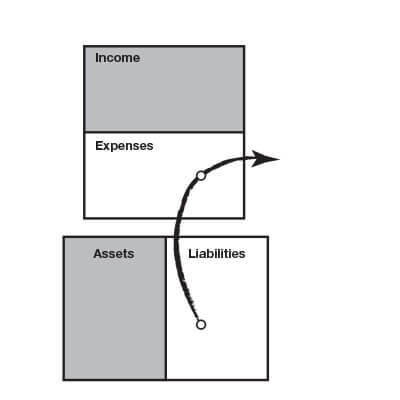
An asset is something that puts money in your pocket. It’s that simple. This is the cash-flow pattern of an asset:
Cash flows from the asset column to the income column
A liability is something that takes money out of your pocket. This is the cash-flow pattern of a liability:
Liabilities take money out of your pocket through your expense column

Where it gets confusing

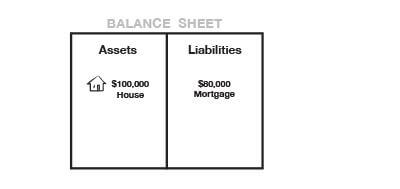
Rich dad pointed out that confusion happens for many because accepted methods of accounting allow for the listing of both assets and liabilities under the asset column.
To explain this, he again drew a simple diagram:
A simplified balance sheet showing a $100k house in the assets column and the $80k mortgage in the liabilities column.
“This is why things get confusing,” rich dad would say. “In this diagram, we have a $100,000 house where someone has put $20,000 cash down and now has an $80,000 mortgage. How do you know if this house is an asset or a liability? Is the house an asset just because it is listed under the asset column?”
The answer is, of course, no. In order to know for sure, you would need to refer to the income statement to see if it was an asset or a liability.

The house as a liability

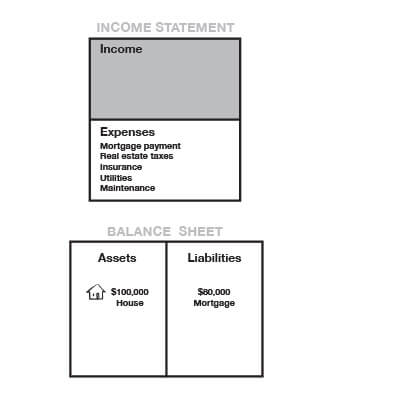
To illustrate this, rich dad drew this diagram:
Income Statement showing expenses but no income from the property. This shows the house is a liability.
“This is a house that is a liability,” said rich dad. “You can tell it is a liability because it’s only line items are under the expense column. Nothing is in the income column.“

The house as an asset

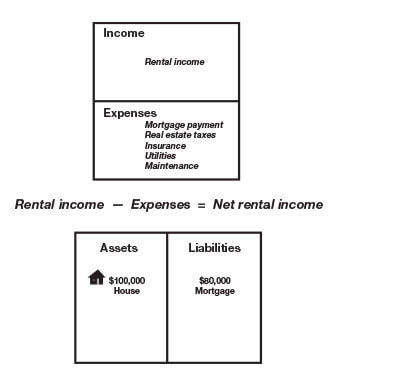
Rich dad then added to the diagram a line that read “rental income” and “net rental income,” the key word being “net.” That addition to the financial statement changed that house from a liability to an asset.
Income statement showing expenses of the property, but this time with a line item under the income column for rents collected. Now the property is an asset.
Very simply, rich dad explained, if the rental income of the house, minus the expenses of the house, equaled positive net rental income, the house is an asset. If not, it is a liability.
These simple lessons are profound. And they are the basis for building all great wealth. Going back to my earlier comment, a person with a high financial IQ and $100,000 would be able to know how to invest it in assets that are true assets—ones that put more money back in the pocket each month. The person with the low financial IQ would spend that same money on liabilities, but wouldn’t be able to diagnose what was wrong. Instead, they would try and work harder to make more money—a vicious cycle we call the Rat Race.
Understanding the relationship between the income statement and the balance sheet allows you to quickly understand if an investment is an asset or a liability—and this understanding will allow you to make the right investment every time.
Think you understand how a financial statement works? Test your knowledge and Play CASHFLOW Classic for FREE.

Source: http://www.richdad.com/Resources/Rich-Dad-Financial-Education-Blog/December-2017/the-financial-statement-foundation-for-being-rich.aspx

Saving for the Future While Paying Off Debt

How can you save for the future when you're still paying off the past?