You often hear people say that rich people are greedy. To that I say, what kind of rich people do you mean?
Most of the entrepreneurs I know are some of the most generous people I know. Not only do they give a lot of their time and money away, but they’ve also built great businesses and products that enrich the lives of people around them.
On the other hand, there is another kind of “rich” person—the high-paid employee. While they may be charitable in their personal life, the high-paid employee can often be very greedy. They will always want more, even when the business is not doing well.
A great example of this is the recent news about Roger Goodell, the Commissioner of the NFL. Goodell is currently negotiating a contract extension with the NFL, and he is asking for a reported $49.5 million a year, lifetime use of a private jet, and lifetime health insurance for his family. He currently makes about $30 million.
The contract negotiation had one anonymous NFL owner saying, “…Several owners in this league who don’t make $40 million a year. That number for Roger just seems too much. It’s offensive. It’s unseemly.”
For those who may not be familiar, until recently, the NFL was a non-profit organization with tax-exempt status. And Roger Goodell is a life-long employee for the organization; having worked his way up from intern to what many people feel is the most-powerful man in sports.
The league’s average TV audience through Week 5 of the 2017 season dropped 7 percent vs. the same period of the 2016 season, according to Nielsen data obtained by Sporting News. Worse for the league, the average game audiences are down 18 percent compared to the first five weeks of the 2015 season.
The NFL’s average TV audience (including Sunday afternoon, Sunday night, Monday night and Thursday night games) slid to 15.156 million viewers through Week 5 of the 2017 season. That’s down 7.42 percent from an average of 16.371 million viewers through the same period of the 2016 season, and 18 percent down from the average of 18.438 million viewers through the first five weeks of the 2015 season.
Additionally, the protests of the national anthem, a host of other scandals, and continued concerns about player head injuries are all dragging the league down.
Call me crazy, but now would not be the time to ask for a 20-million-dollar raise. Yet, that’s what Goodell is doing. That is greedy.
All of this is a good reason to contrast three mindsets of employee versus entrepreneurs.
Entrepreneurs take ownership; employees take from ownership
One of the things I love about successful entrepreneurs is that they put their businesses first. If the business is struggling or not making money, they don’t make money and they are responsible for fixing it. They have to take ownership.
Employees, on the other hand, don’t have to make the sacrifices that owners do in that regard. In fact, many of them, like Roger Goodell, want more money even when the business is struggling. If they don’t get their raise, they move on to another company.
Starting a business can be a rocky endeavor, with a lot of risk and instability. Yet, successful entrepreneurs are able to take chaos and make it into a thriving business that provides stability for many working families.
Employees greatly fear instability and demand stability from their employers. One of the reasons employees want more and more from entrepreneurs, even when the business isn’t doing well, is because they think money provides stability. Unfortunately, it doesn’t, as many riches to rags stories can attest to.
The reality is that being an employee is highly risky. You have no control and you pay the highest in taxes. And if the business goes bad, you’re the first to be laid off—especially if you’re asking for more money at the time.
Entrepreneurs look at results; employees look at tenure
When things go wrong, a successful entrepreneur is the first to raise her hand and admit it was her fault. And when it comes to rewarding talent, it is based on results not effort or tenure.
Conversely, employees think that effort or tenure should be rewarded. This is why someone like Goodell, who has spent his entire life working for the NFL, can feel comfortable asking for so much money.
At the end of the day, tenure and effort are worthless unless you have results. Entrepreneurs understand this because if there are no results, they have to close the business. They can’t tell their investors they tried hard or lean on the fact they’ve been open for business for twenty years.
Which mindset do you want?
At the end of the day this is not a knock on employees. I have many people who work for me. They are wonderful people, but they think very differently than I do. That’s OK. It’s just not OK for me to think the way they do. I’m not wired that way.
Sometimes, people choose one path but change later. These become employees that operate like entrepreneurs in your organization. They are your most valuable employees—and usually the ones who leave pretty quickly, often to start their own thing—as happened to me recently. While it is no fun to lose a great employee, it is a lot of fun to see him become an entrepreneur. His mindset changed. In the process he brought more value to my organization, and later to his own life.
Each and every one of us must at some point decide what path we will follow—that of the entrepreneur or that of the employee. Which will you choose?
“All men dream, but not equally. Those who dream by night in the dusty recesses of their minds, wake in the day to find that it was a vanity: but the dreamers of the day are dangerous men, for they may act on their dreams with open eyes, to make them possible.” – T.E. Lawrence
Steve Jobs called them “crazy ones,” T.E. Lawrence called them “dangerous men,” but both recognized that those who dare to live their dreams are powerful outliers. Although we all have dreams, very few of us follow through to make our dreams a reality.
What is your dream? Are you living it? Or is it more of a blurry vision, like a mirage teasing you in the distance? Maybe you want to lose 50 pounds, or to connect with your teenage daughter. Maybe you want to become absolutely financially free, or to finally buy that condo in Aspen.
The truth is that most people are not where they want to be simply because they never get started. Perhaps you don’t know where to start, or perhaps you have been too scared to start. Whatever the reason, now is the time to break through the excuses, the fear, the scarcity mindset. It’s time to take the first step. Because once you start, you will gain momentum. And once you gain positive momentum, it becomes so much easier to succeed.
The momentum model is specifically designed to create tangible results by allowing you to just take one step at a time. Before you know it, just like ball rolling downhill, you will pick up speed and become a driving force.
1. PUT YOURSELF IN A PEAK STATE
First things first: if you want to change the results of anything, you first must put yourself into a peak state. This means you massively change your physiology in order to maximize energy levels. If you remain in a low-energy state, you will not change anything because it will only remain a concept in your head.
Do whatever you need to do to get into this state: jump up and down, dance, yell. Channel an enthusiastic sports fan or a teenage girl at a Taylor Swift concert.
2. FIND YOUR PASSION
Once you are in a peak state, in order to keep the momentum going, you must tap into your passion. If you don’t know what your passion is, then being in a peak state is the perfect state to be, because it as if you have primed the pump. When you find your passion, it will be like you have tapped the well and your energy will be sustained by your passion.
But, to find your passion you must ask the right questions. What do you love? What do you hate? What will you not tolerate? What makes you say, “Not another day, not another hour, this is changing now!”
Write it all down. Go on a rant. And be sure to do it with energy and passion!
3. DECIDE, COMMIT, RESOLVE
Finding your passion is going to give you tremendous energy, but to maintain the momentum, you must do the next thing. The decision really is the power that changes your life. Make this decision while you’re still in a passionate state. If you make a decision without passion, you will kill the momentum.
Decision is like war – the internal back and forth – until you say, “Alright, I’m going to make myself do this.” After you have made your decision, you must commit that no matter whether it is easy or difficult, you are doing it. And finally you must resolve. Resolve means it’s done – there is no question whatsoever.
Remember two decisions you have already made sometime in the past that changed your life for the better. Maybe it was a small but difficult decision and it led to something really important in your life. Then think of a big decision – maybe one that you came to the edge of doing multiple times and kept pulling back. But eventually you did it, and it changed your whole life for the better. What finally got you to decide? Write down two decisions, one small and one large, that if you decided today they would change your life for the better. Once you’ve decided, commit to them. Finally, be resolved, knowing it’s a done deal. Resolve brings peace because the internal wrestle is over.
4. TAKE IMMEDIATE, INTELLIGENT, CONSISTENT AND MASSIVE ACTION
After you are resolved, the only way to keep the momentum is to take immediate and massive action. Massive action is the cure-all. If your relationship is not where you want it to be, if your finances are not where you want them to be, or your body, or your business, whatever the case, you need to take massive action. And if it doesn’t work, try something else. Continue to take massive action until you find a way forward.
Now close your eyes and decide what two actions you are going to take immediately on your first decision. Make a phone call, schedule a meeting, enroll in a class. But do it immediately because otherwise, despite your best intentions, you likely won’t follow through.
5. BE S.M.A.R.T. — AND BE HONEST WITH YOURSELF
The last step to continue the momentum you’ve got is to be S.M.A.R.T. Make sure the results you are moving toward are Specific, Measurable, Achievable, Realistic and anchored within a Time frame. Is your action working? Be honest with yourself. If it is not, go back into peak state and work through Step 4, with a new action. Wash, rinse, repeat — until you find an action that does work for you.
Do not be content to be mediocre when your heart aches for so much more. Be courageous enough to take the first step and allow the power of momentum to propel you into a future where your dreams become reality.
The key to financial success is understanding the relationship between the income statement and the balance sheet
What does it mean to be rich?
This is perhaps the most important question you can ask and answer. For most people, being rich means making a lot of money. They think that if they can just make a little more each month, all their problems will be fixed. They’ll live like kings and queens.
Living like kings and queens?
So, let me ask you this, would making $100,000 a year make you rich? My guess is that the average person making $59,000 a year would say yes. But like beauty, being rich is in the eye of the beholder.
NPR recently profiled the lives of people living on $100,000 a year. The article sheds some surprising light on the struggles these so-called rich people have. In most cases, the money is quickly eaten away by things like mortgages or rent, student loan debt, and family obligations. In most cases, the people are trying to keep up with the Joneses…but at quite a cost.
One mother, Theresa Sahhar, whose husband’s salary of $100,000 (equivalent to $250,000 in Manhattan cost of living) still works various odd jobs in the gig economy to put her son through a private high-school. She shares with NPR, “I was really surprised because from the outside, it looks like we have plenty of money. But then when you really look underneath it all, you see that people are working overtime. They’re working second jobs and even third jobs to try to put together the money just to stay in the middle class where they’ve been in the past.”
It would be tempting to say that these are just extreme examples…except they’re not. The reality is that $100,000 really doesn’t go that far—especially when you don’t have a robust financial education.
Where financial literacy begins
The reality is that money doesn’t make you rich. What does make you rich is your financial IQ. Give the same $100,000 to a person with a low financial IQ and a person with a high financial IQ and I guarantee you’ll see a vast difference in how that money is spent and grown.
Central to the difference between those with low and high financial IQs is a simple but profound literacy: the ability to understand a financial statement.
One of the most important things you need to know in order to be financially successful is to read an income statement and balance sheet.
But even more important is understanding the relationship between them.
Many people learn in accounting classes how to read an income statement and balance sheet separately. I’ve always found it fascinating, however, that these classes don’t teach why one document is important to the other or how one affects the other.
My rich dad, however, felt that the relationship between the two was everything. “How can you understand one without the other? How can you tell what an asset or liability really is without the income column or the expense column?” he asked.
For rich dad, understanding the relationship between the two allowed you to easily see the direction of your cash flow to easily determine if something was making you money or not.
If something was making money, it was an asset. If not, it was a liability.
“Just because something is listed under the asset column does not make it an asset,” said rich dad. “The reason people suffer financially is that they purchase liabilities and list them under the asset column.”
The magic words are cash flow
It’s this simple insight that explains why those with a low financial IQ are still poor even when they make more than $100,000 a year. They don’t know how to move their money into assets that make them more money. Instead, they spend it all on liabilities and live large paycheck to large paycheck.
To rich dad, the most important words in business and investing were cash flow. He would say, “Just as a fisherman must watch the ebb and flow of the tides, an investor and businessperson must be keenly aware of the subtle shifts in cash flow. People and businesses struggle financially because they have poor control of their cash flow.”
KISS (Keep It Super Simple)
One of my rich dad’s greatest skills was to take complex things and make them super simple. It was one of his rules for investing—KISS, keep it super simple. He had a way of taking complex financial subjects and making them easy enough for even a nine-year-old boy to understand.
I know this because when I was nine, rich dad used the following simple diagrams to teach me the relationship between the income statement and the balance sheet. I still use them to this day.
If you can understand the following diagrams, you have a better chance of acquiring great wealth.
Cash flow patterns
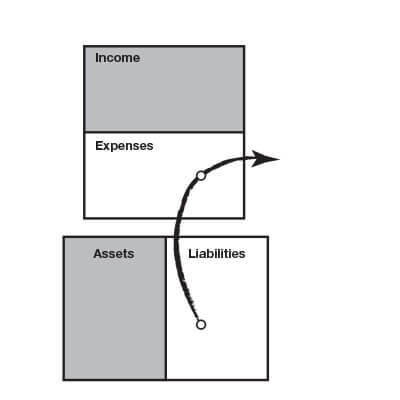
An asset is something that puts money in your pocket. It’s that simple. This is the cash-flow pattern of an asset:
A liability is something that takes money out of your pocket. This is the cash-flow pattern of a liability:
Where it gets confusing
Rich dad pointed out that confusion happens for many because accepted methods of accounting allow for the listing of both assets and liabilities under the asset column.
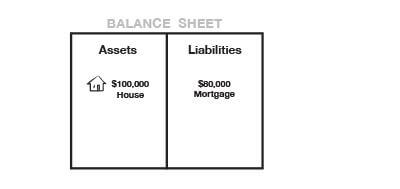
To explain this, he again drew a simple diagram:
“This is why things get confusing,” rich dad would say. “In this diagram, we have a $100,000 house where someone has put $20,000 cash down and now has an $80,000 mortgage. How do you know if this house is an asset or a liability? Is the house an asset just because it is listed under the asset column?”
The answer is, of course, no. In order to know for sure, you would need to refer to the income statement to see if it was an asset or a liability.
The house as a liability
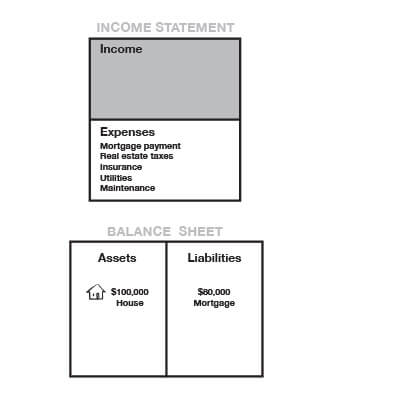
To illustrate this, rich dad drew this diagram:
“This is a house that is a liability,” said rich dad. “You can tell it is a liability because it’s only line items are under the expense column. Nothing is in the income column.“
The house as an asset
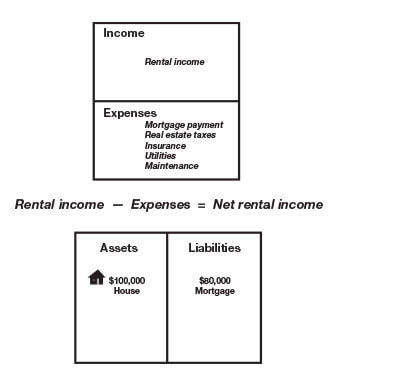
Rich dad then added to the diagram a line that read “rental income” and “net rental income,” the key word being “net.” That addition to the financial statement changed that house from a liability to an asset.
Very simply, rich dad explained, if the rental income of the house, minus the expenses of the house, equaled positive net rental income, the house is an asset. If not, it is a liability.
These simple lessons are profound. And they are the basis for building all great wealth. Going back to my earlier comment, a person with a high financial IQ and $100,000 would be able to know how to invest it in assets that are true assets—ones that put more money back in the pocket each month. The person with the low financial IQ would spend that same money on liabilities, but wouldn’t be able to diagnose what was wrong. Instead, they would try and work harder to make more money—a vicious cycle we call the Rat Race.
Understanding the relationship between the income statement and the balance sheet allows you to quickly understand if an investment is an asset or a liability—and this understanding will allow you to make the right investment every time.
How to become a millionaire or multi-millionaire or even hecta-millionaire (100 million units) isn’t taught in schools or colleges. In fact, most ofsociety frowns on anyone who talks about getting rich; some even protest against those who have created financial independence.It’s a funny thing that schools teach you how to read and write, how to domath, how to know history and geography, and how to pass a test—but they never broach the subject of how to get rich. Getting super rich seems to be a topic reserved for fantasies, movies, and drunken what-if games. Most have come to believe that becoming a millionaire is for the lucky sperm club, business owners, gold diggers, lottery winners, athletes, rappers, and inventors. But it’s not true. Millionaires and the super rich come from all walks of life. In fact, just to debunk one of the myths, I’ll tell you that four out of five millionaires today work for someone else.
The reason most people never get rich is that they never even consider it a possibility. They are convinced by those close to them to simply be satisfied with whatever their financial situation is. The other reason is that people fundamentally do not understand money. Very few people know how to get money, even fewer know how to keep it, and almost no one knows how to multiply it. Just look around and you will see signs of this everywhere. Even in one of the richest countries in the world, America, 76 percent of people live paycheck to paycheck, some 50 percent of Americans have no money for retirement, and 47 percent of Americans don’t have $400 for an emergency. If these statistics were true in a poor country, it would be one thing, but America is considered a wealthy country.
Turn on the television or go online and you will see endless, ridiculous financial advice. Financial pundits suggest saving tricks where your path to wealth is finding the lowest price for a product or putting more air in your tires to save gas. This piece of advice always cracks me up: “If you don’t drink coffee out, you’ll save another $700 a year.” You can save $700 a year for the next fifty years and you won’t be rich, you’ll just be old. Another pundit preaches all debt is bad, and that by avoiding debt you will somehow be financially free. “Never borrow money under any circumstance,” the previously bankrupt advisor promotes. He overlooks the reality that almost all the super rich have used debt to multiply their wealth. Flip the channel and you’ll see fancy graphics making a case that you should turn your money over to the boys on Wall Street who, smarter than you, will invest in stocks, bonds, and financial instruments they can’t even explain. Ask your parents for money advice and they will recite their path: get a good job, buy a house, contribute to your 401k, be grateful you have more than most, and pray everything goes right.
I have never wanted to just have “enough,” in fact, truth be known, I have always wanted to be rich. While I do believe in prayer, I don’t expect God to take care of my finances and I certainly don’t want to leave it up to everything “going right.” At a very young age, I noticed how the people who made the decisions and had the power of choice all seemed to be the people with money. I wanted to be one of them. I didn’t want money for the sake of money, but to be able to have the power of choice. At the age of eight, one of my first experiences with money was walking to the local grocery store. I had a quarter in my pocket to spend at the store. I was excited, giddy, and I felt powerful. I was walking to the store with my brother fondling my quarter when I dropped it in the street and it rolled into a manhole. I got onto my hands and knees, only to discover my arms were too short to retrieve the quarter. I got up wet, dirty, angry, and wanting to cry. I remember going home and telling my father how I had lost my quarter. My father said to me, “You shouldn’t play with money.” My grandfather later grabbed me and said, “Son, the problem isn’t simply that you lost the quarter; the problem is that it was your only quarter.” Since that loss I have been fascinated with the idea of amassing enough money so no single event or loss would ever cause me to be without.
If you can relate to what I’m talking about, get on my new Playbook to Millions. It’s a program I put together from my 30+ years of experience going from broke to becoming a millionaire over 100 times over. Later this year I’ll be selling this thing for $5,000 but for those who commit to it early—right now—it’s marked down to just $495. You can and should be a millionaire, and you shouldn’t have to wait until you’re old to become one. Get your Playbook today.